

A small collection of table clocks consigned for the Summer Fine Sale all date from the 18th century. However, differences in style and features to the cases and dials help date the clocks to three distinct clock-making periods spanning thirty years.
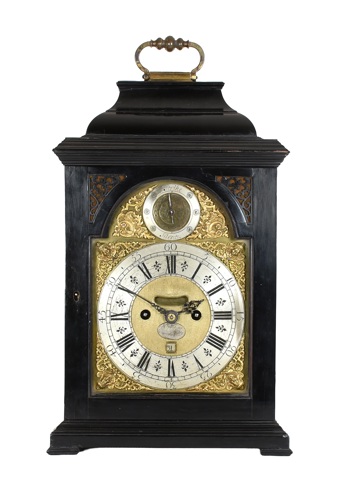
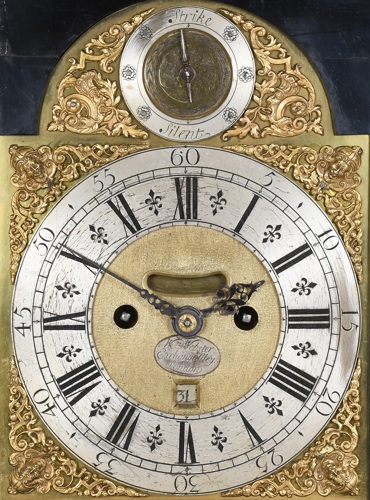
An Ebonised Table Clock, signed Wm Webster, Exchange Alley, London (estimate: £1,200-1,500 plus buyer’s premium).
The earliest clock was made by William Webster, a London clockmaker known for good quality clocks. The Webster family were one of the great clockmaking dynasties of London, having been founded in Exchange Alley in 1711 by William Webster I who had been apprentice and journeyman to the famed clockmaker Thomas Tompion. His son William Webster II took over the business in 1734, the year before his father died, and became Master of the Clockmakers’ Company in 1755. The family business continued operating until the early 20th century.
The present clock exhibits the qualities and features of clocks by William Webster II, and has an inverted bell top, gilt brass carrying handle, and features popular in the 18th century such as the strike/silent selection in the arch of the dial and the mock pendulum aperture to the dial centre. However, a date of circa 1740 for the clock is indicated by the dial chapter ring having half hour fleur-de-lis and inner quarter hour markers.
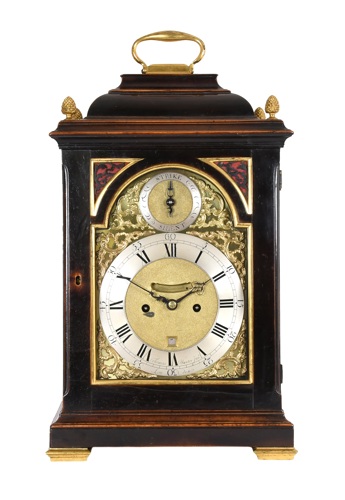
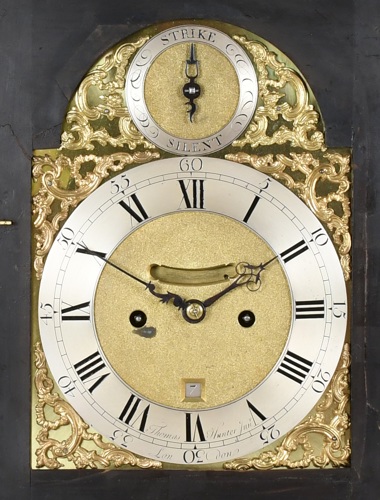
An Ebonised Table Clock, signed Thomas Hunter Junr, London (estimate: £1,200-1,800 plus buyer’s premium)
Dating from circa 1750 is an example by Thomas Hunter Junior of London, who is recorded in Watchmakers and Clockmakers of the World by G.H. Baillie as having been apprenticed in 1734 and gaining his freedom in 1742. He worked from New Broad Street Buildings and was appointed Warden of the Clockmakers’ Company in 1762 and served as Master in 1765 before dying in 1785. Similar to the previous example, Hunter’s clock has the inverted bell top and brass carrying handle along with brass finials and an ebonised mahogany case, along with a pull side repeat cord which activates the pull quarter repeat mechanism to strike a nest of bells for the quarters and hours. It also has the same strike/silent selection and mock pendulum aperture. Specific features that date the clock to circa 1750 are the lack of half hour fleur-de-lis and inner quarter hour markers, which disappeared from clocks between 1750 and 1760.
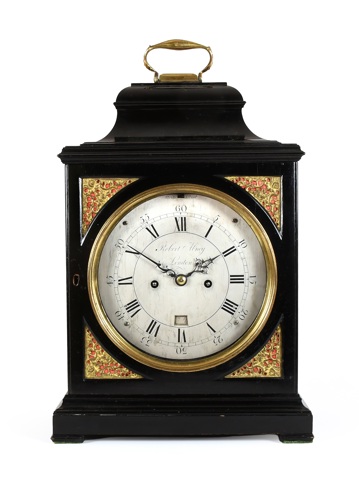
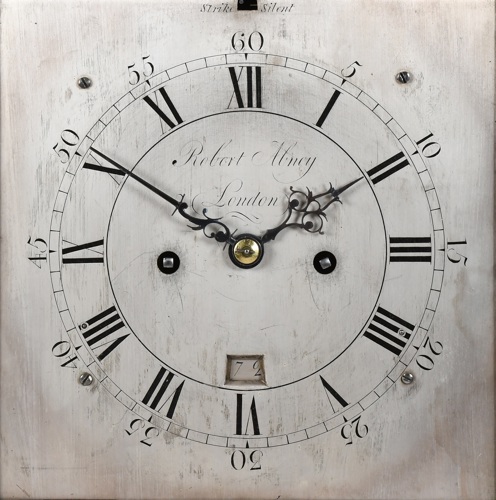
An Ebonised Table Clock, signed Robert Abney, London (estimate: £700-900 plus buyer’s premium)
Finally, from this collection, is a table clock made by Robert Abney of London, which has an ebonised case with inverted bell top and brass carrying handle, and the strike/silent feature which continued to be present on table clocks into the 19th century. Indicating a date of circa 1770 in the Early Georgian period is the one-piece brass silvered dial, which began to be introduced to clocks from 1770-1775.
Entries of Clocks for the Summer Fine Sale are now invited. To discuss consigning clocks, contact Adam Wasdell.