
“What is selling well at the moment?”
As auctioneers we are asked this question often, and in the jewellery department the answer is very simple - antiques. Whilst modern jewellery sells well, the most competitive bidding is seen on antique pieces, especially when they are in good condition. Collectors adore antique jewellery that pre-dates 1900, however, early 20th century period jewellery, notably of the Edwardian era, offers more wearable styles and dominates the attention of our buyers on viewing days. There are several beautiful, elegant pieces coming up in the Jewellery, Watches and Silver Sale on 12th September.
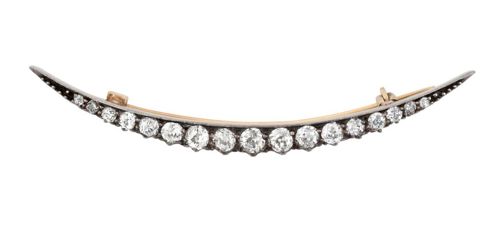
A Diamond Crescent Brooch, circa 1880 (Estimate: £300-500 plus buyer’s premium).
A circa 1880 Diamond Crescent Brooch is a good example of a jewel that demonstrates the start of the transition from Victorian to Edwardian taste. Whilst it incorporates the Victorian requirements for traditions using diamonds and incorporates the popular 19th century theme of a crescent moon, it hints at the more modest Edwardian style with a sleek and very slender appearance.
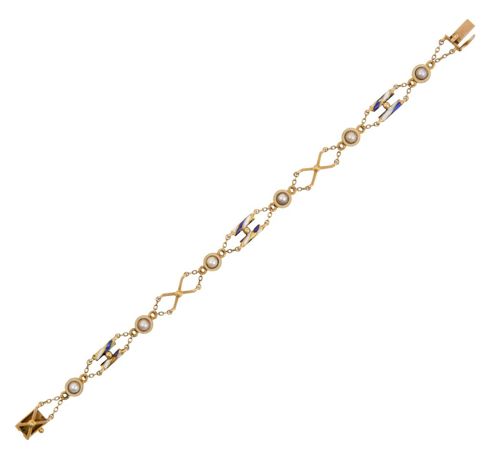
A Split Pearl and Enamel Bracelet, circa 1900 (Estimate: £300-500 plus buyer’s premium).
One of the most wearable pieces of antique jewellery in the sale is a Split Pearl and Enamel Bracelet, which was made circa 1900. It has a simple geometric form, enamel barrels and seed pearls inset.
Before the Art Deco movement took hold in the mid-1920s, the Edwardian style in Great Britain continued to shift from the bold, chunky objects of the Victorian era that were designed to impress using volume, to more streamlined designs. This simpler aesthetic was sparked in the mid-1800s by the Pre-Raphaelites as a backlash to industrialisation. Their artistic ideals included beautiful decoration for everyday objects. The Pre-Raphaelite brotherhood was superseded by the Arts and Crafts movement, which intertwined and overlapped with the Art Nouveau style throughout the end of the 19th century into the start of the 20th century.
Traditional jewellery found a middle ground in the Edwardian era, embracing natural themes by using bird and flower motifs, employing organic gems such as turquoise and pearl, and moving away from the classic large diamonds and gemstones designed to display wealth and infer status.
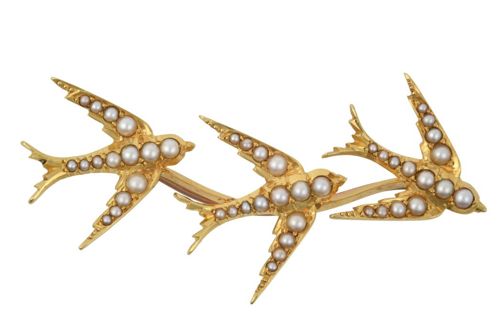
An Early 20th Century Split Pearl Brooch (Estimate: £200-300 plus buyer’s premium)
Comprising three swallows in flight, is an Early 20th Century Brooch set throughout with seed pearls. Many bar brooches use a straight bar, but one of the pleasing details of this piece is an undulating bar that enhances the appearance of the birds in flight.
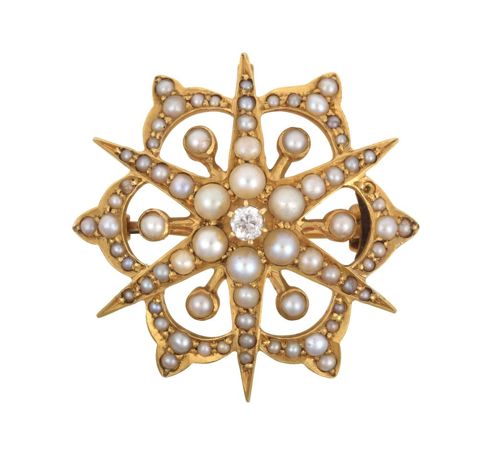
A Split Pearl and Diamond Brooch/Pendant, circa 1900 (Estimate: £120-180 plus buyer’s premium)
Also using pearls throughout is a Split Pearl and Diamond Brooch/Pendant, which was made circa 1900. These versatile pieces of jewellery usually have a pendant loop that detaches, or folds inwards to facilitate varied use. Alas, one is lacking here, but occasionally, we find such objects in their original fitted case, sometimes with a hair pin in the base, offering yet more potential.
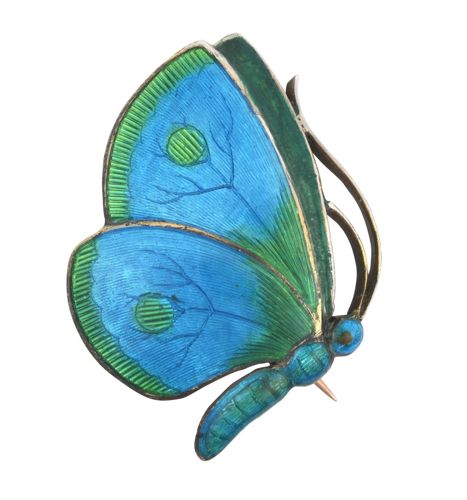
An Enamel Brooch by Child & Child, circa 1905 (Estimate: £200-400 plus buyer’s premium)
Famed gold and silversmith firm Child & Child was based in London from the late 1800s until 1916. The brothers’ partnership was known for beautiful nature inspired pieces, usually including exquisitely detailed enamel. One of the most well-known Pre-Raphaelites, Edward Burne-Jones, commissioned Child & Child to make jewellery to his design, and the firm included another key member of the Pre-Raphaelites amongst their clients – William Holman Hunt. A superb example of their work in the form of a butterfly brooch exhibits enamelling that is typical of their craft, and it includes an engraved date of presentation of 1907 and is sold with its fitted case. Whilst fewer people wear brooches today, there are many collectors of brooches, and enamelwork, by such well-regarded makers.
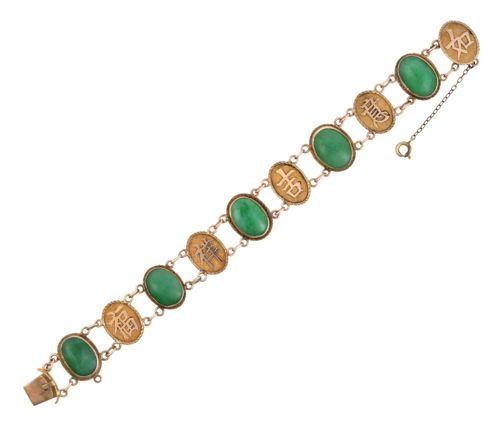
A Jade Bracelet (Estimate: £600-800 plus buyer’s premium
Liberty & Co. was founded in 1875 and included many Pre-Raphaelites amongst their clientele. By the late 19th century the founder, Arthur Lasenby Liberty, was encouraging more Arts and Crafts designers to include their work in his store, moving away from the imported Eastern pieces he had become famous for. This Jade Bracelet is sold with its fitted Liberty’s case and could have been one of Liberty’s pieces imported for stock, or, equally, it is possible it was from one the artists they commissioned, many of whom embraced the Eastern style. With such wearable elegance we expect this to attract much attention at the viewing and sale.