
“Pablo loved to surround himself with birds and animals. In general they were exempt from the suspicion with which he regarded his other friends.” – Françoise Gilot
In 1946, during a period of calm in a somewhat turbulent life, Picasso befriended an owl.
After ending a rather tumultuous relationship with his muse, the photographer and painter Dora Maar, Picasso spent six months living in the Château Grimaldi in Antibes with the artist Françoise Gilot, whom was forty years his junior and with whom he would spend a decade and have two children.
The Château, which was perched right on the edge of the water, was built in the 14th century atop the foundations of the Ancient Greek settlement of Antipolis. Today it is the Musée Picasso. Surrounded by the glowing light and sparkling seas of the Cote d’Azur, Picasso worked prolifically, experimenting with new mediums, especially ceramics, in an air of comparative domesticity for the artist.
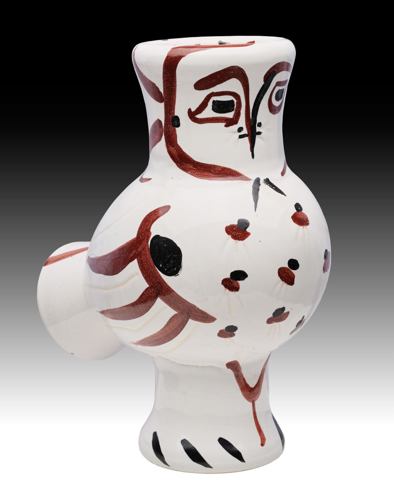
Pablo Picasso (1881-1973) Spanish, Wood-owl
Modern & Contemporary Art Sale, 13th June 2026 - Estimate: £3,000-5,000 (plus buyer’s premium)
One day, a tiny owl was discovered in the ramparts of the medieval building; having a broken claw, the couple decided to nurse him back to health, acquiring a cage and settling him in the kitchen with a menagerie of other animals. Later writing of the incident Gilot said: “We were very nice to him but he only glared at us… he remained stolidly silent or, at best, snorted”. Determined to befriend the creature, Picasso would poke his fingers through the bars of the cage and eventually established enough trust to have the owl perch on his finger. Although, if the bird ever bit him, he was not averse to hurling insults right back at the creature. The owl soon became a fixture of Picasso’s studio and a timely muse.
Owls have long been a symbol of wisdom and watchfulness and having a fascination with and deep understanding of ancient cultures, Picasso was very much aware of the association of owls with the goddess Athena and their frequent presence in the decoration of ancient pottery. Serendipitously, the owl was also the ancient symbol of Antibes, the town having been founded on an Ancient Greek settlement.
Animals, and particularly birds, had played a vital role in Picasso’s life since his childhood, and were frequently depicted in his art, so it is little wonder that soon, Picasso began incorporating images of owls into his work - into his drawings, paintings, and most importantly into his ceramics. The owl proved a versatile form, with a rotund outline and expressive eyes which could be translated into simple Cubist forms. Picasso created strikingly modern takes on an ancient symbol.
Picasso began producing ceramics at the family-run Madoura pottery in Vallauris, a little way inland from Antibes and the site of clay production since Roman times. Here, over the course of twenty years, Picasso would create hundreds of unique and editioned ceramic pieces, often exploring anthropomorphic designs, classical imagery and whimsical animal forms.
One of his most iconic shapes was the pottery owl vase, with a bulbous body tapered top and bottom to form the head and legs, and often with extra clay added to form a tail. Simple in shape, it could be quickly painted with bold and energetic brushstrokes to form a characterful owl. Picasso produced both unique hand-built examples, and editioned pieces made with clay moulds, which are often marked on the base ‘Edition Picasso’ as seen in the present piece.
The owl continued to be a recurring motif in Picasso’s oeuvre throughout the 1950s and 1960s, and this charming editioned version of the Wood-owl is coming up in the 13th June Modern and Contemporary Art Sale with an estimate of £3,000-5,000 plus buyer’s premium.