

Throughout history, gold jewellery has been highly prized and used to display wealth and status. For many cultures around the world, traditional yellow gold has been the preferred form of the metal, particularly in the higher fineness’s where the luxurious, inimitable deep yellow colour is more pronounced.
In modern times, particularly from the early 20th century onwards, white gold began to be frequently incorporated in jewellery design, both to suit changing fashions and tastes, and to meet new technical demands. At times, yellow gold has shared centre stage with white gold, platinum and other white metals in jewellery making, however fashion cycles saw yellow gold experiencing surges in desirability. Many readers will remember it being at the peak of its popularity in the 1970s and 1980s and then waning throughout the following decades as minimalism and white metals overtook the chunky statement jewellery styles once more.
Recently, retail jewellers have reported an increased demand for yellow gold for wedding bands, statement jewellery and gemstone settings, and in the last twelve months gold trading values internationally have soared, pushing gold jewellery further into the luxury and status end of the market once more.
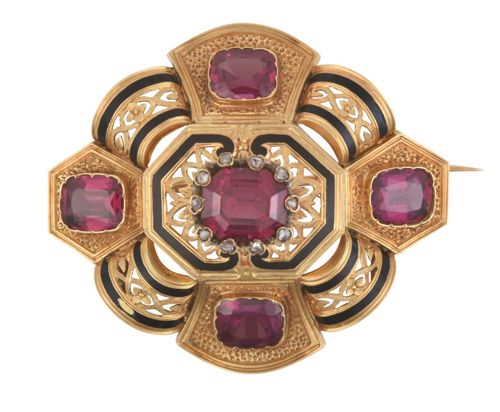
A Garnet, Diamond and Enamel Brooch, circa 1860 (estimate: £500-700)
Amongst the 150 lots coming up in the Jewellery, Watches and Silver Sale on 16th May are antique gold pieces which would not look out of place on the catwalk today. One of the finest examples is a circa 1860 Garnet, Diamond and Enamel, a superb example of late 19th century jewellery Brooch (estimate: £500-700). The yellow gold is modelled as a tiered brooch, with a beautiful purply-red garnet set proudly to the centre, within delicately modelled pinched claw settings each containing a rose cut diamond. This sits above a pierced octagonal frame with black enamel detailing to an outer undulating frame with four geometric beaten panels, each set with a smaller garnet in the same colour, alternating with pierced curved floral decorated sections, again with black enamel detailing. To the reverse a pin and hook fastener and three additional hooks are suggestive of versatile uses for the jewel.
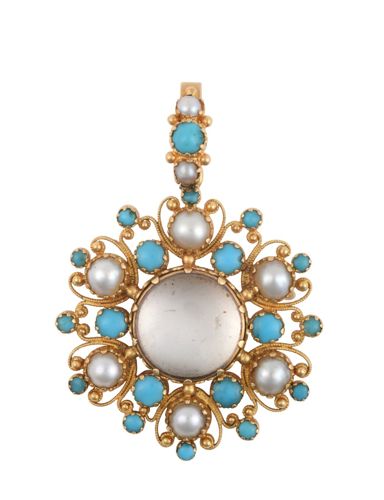
A Turquoise and Split Pearl Pendant, circa 1880 (estimate: £100-150)
Several turquoise-set jewels are also on offer, one of the more intricate of these being a circa 1880 Turquoise and Split Pearl Pendant with a locket compartment placed centrally within a scrollwork border, set with cabochon turquoise and half pearls inset into pseudo heart shaped settings (estimate: £100-150).
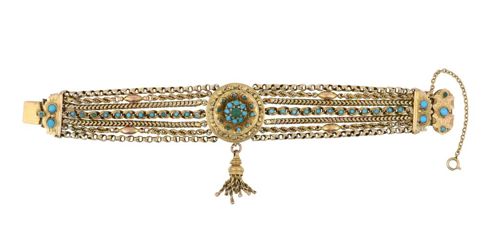
A Victorian Turquoise Bracelet (estimate: £1,200-1,800)
Other turquoise set examples of gold jewellery include a late 19th century Victorian Turquoise Bracelet with multiple rows of chain with a circular chased central panel with tassel suspension and ornate clasp with a further turquoise inset (estimate: £1,200-1,800).
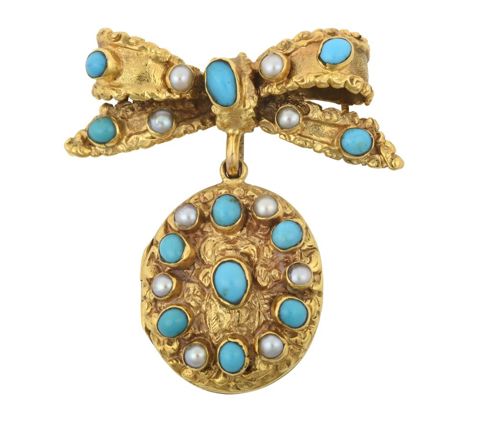
A Turquoise and Split Pearl Brooch (estimate: £200-300)
Also featuring a locket aperture is a more modern example likely dating to the mid-20th century, a Turquoise and Split Pearl Brooch in the form of a bow with an oval chased locket pendant (estimate: £200-300).
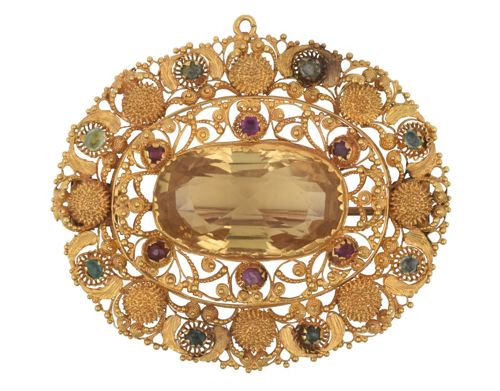
A Mid-19th Century Multi-Gem Set Brooch (estimate: £300-500)
Showcasing cannetille settings, formed of scrolls, coils and granulation made from gold wires, is a large mid-19th century Multi-Gem Set Brooch with a complementary oval Citrine of a significant size, centrally set to a delicate outer border set with six rubies and an outer beaded and spike decorative border set with emeralds at intervals (estimate: £300-500).
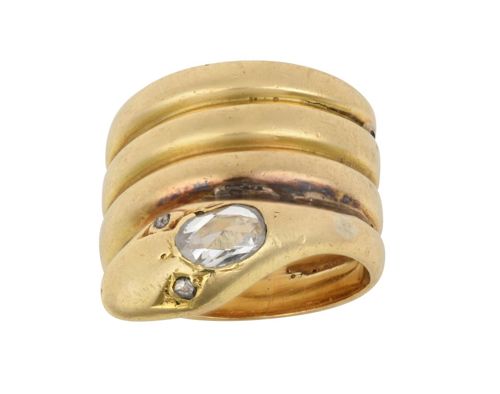
A Diamond Snake Ring, circa 1870 (estimate: £400-600)
Collectors of antique gold jewellery will be further enchanted by a circa 1870 Diamond Snake Ring modelled as a coiled snake with a rose cut diamond set to the top of its head and two smaller diamonds set as eyes (estimate: £400-600).
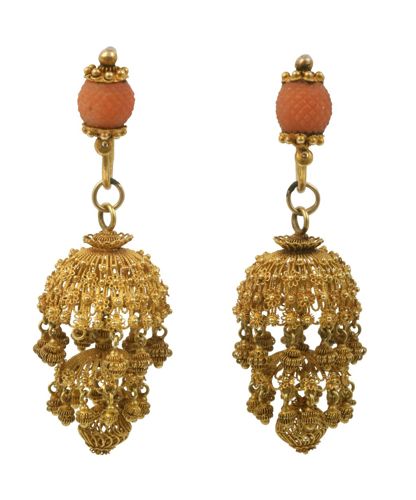
A Pair of Coral Earrings (estimate: £300-500)
Earrings are also included, such as a Pair of Coral Earrings, which have an unusual hook-style fitting, with a carved coral bead and suspensions of filigree and cannetille gold work, truly mesmerising suspended from the ear (estimate: £300-500).
All figures exclude buyer’s premium.