
For centuries pictorial tapestry wall hangings were one of the most important forms of ‘high art’ in domestic settings in Northern Europe; not only did they bring decoration and colour, but they provided insulations from drafts and damp stone walls. Enormously costly, they were the preserve of the upper echelons of society and were lavish demonstrations of wealth and culture. Indeed, Henry VIII is said to have owned over 2,000 tapestries. Today, antique tapestries are relatively rare considering how important they once were, having succumbed to changes in fashion, damp, pests and fading.
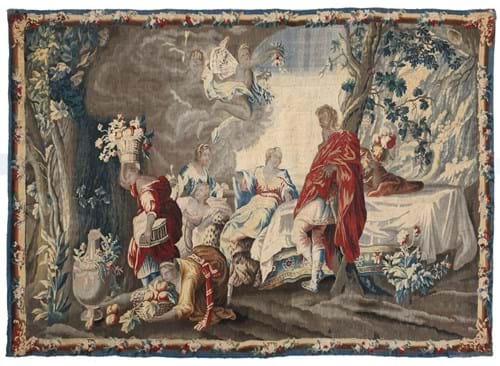
A Louis XIV Aubusson Mythological Tapestry, Perhaps from the Story of Ulysses and Circe, Corby Castle Sale – 22nd – 24th January
Estimate: £4,000-6,000 plus buyer’s premium
Fragments of woven tapestry-like textiles have been found dating back to ancient times; however, it was between the 14th and late 18th centuries that tapestry wall hangings flourished. Production was centred in France and the Low Countries, with later notable manufacturers springing up in Germany and England, such as the Mortlake workshops on the River Thames. Perhaps the most renowned manufacturer was the Gobelins factory, established in Paris in 1631, which supplied the court of Louis XIV with tapestries made to the designs of Charles Le Brun.
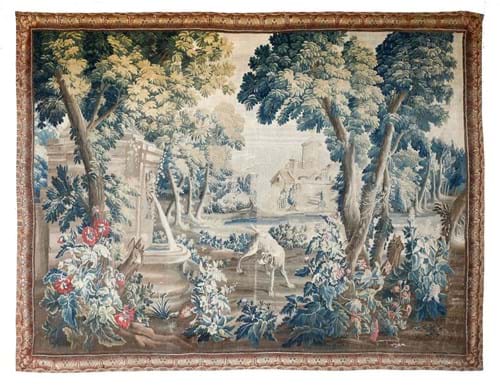
A Louis XV Aubusson Verdure Tapestry, Attributed to the atelier of Jacques Dumonteil from the model by Jean-Joseph Dumons after Oudry, Corby Castle Sale – 22nd – 24th January
Estimate: £4,000-6,000 plus buyer’s premium
Tapestries were made on large-scale looms; vertical plain threads (the warp) were tensioned on the loom to form the structural base of a tapestry, onto which coloured threads (the weft) were woven horizontally in patches of colour to form the design. Sporadically, weavers would beat the weft threads down tightly, completely covering the warp threads in the final design. Wool was the material used most frequently to make tapestries, being strong, easy to dye and relatively cheap although coarse. Finer tapestries utilised silk threads, which could be woven into finer detail, or even costly metallic threads. No matter the material, they were extremely labour intensive.
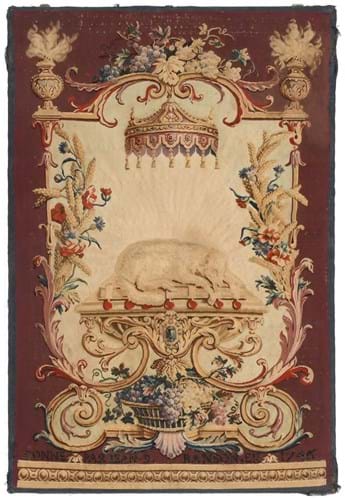
Brussels Tapestry, Attributed to Pieter Van den Hecke, after Jan Van Orley, from the Story of Cupid and Psyche, Venus spilling drops of oil on the sleeping Cupid, Corby Castle Sale – 22nd – 24th January
Estimate: £2,000-3,000 plus buyer’s premium
The weavers would be provided with an intricately drawn design to copy, known as a cartoon. Perhaps the most famous of these to survive are the extraordinary Raphael Cartoons, now on loan to the V&A from the Royal Collection. The cartoons were drawn by the legendary Renaissance artist Raphel Sanzio for Pope Leo X and depict the Acts of the Apostles. Once they had been used in Italy, in 1623 the designs were bought by the future King Charles I, where they were used to create a new set of tapestries in the Mortlake workshops.
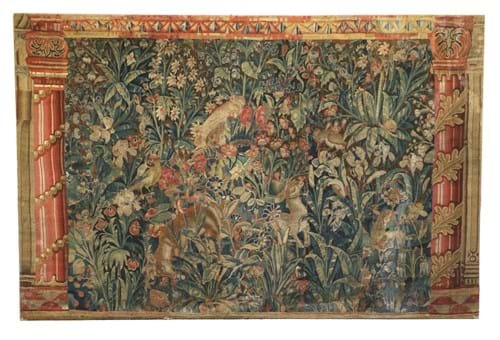
Franco-Flemish Millefleur Tapestry, 16th century
Sold for £6,500 plus buyer’s premium
Often made in sets, tapestries frequently told complex allegorical or narrative stories across multiple hangings. Classical mythology, historic battles, and biblical stories were popular subjects, as were hunting scenes. Earlier tapestries were often woven with intricate floral designs, with animals added with little concern for realism; these were called millefleur tapestries, and later verdure designs became popular which solely consisted of intricate and often naturalistic scenes of foliage.
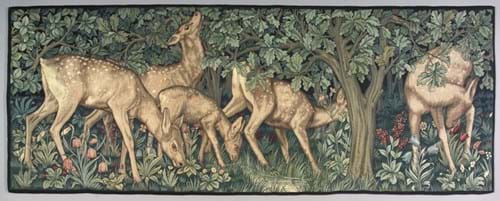
A Morris & Co. Tapestry designed by Henry John Dearle
Sold for £54,000 plus buyer’s premium
Gradually, tapestries faded out of fashion in the late 18th century only to once more be brought out of obscurity by the Arts and Crafts movement at the end of the 19th century, which championed historic forms of hand-made art and furnishings in reaction to the era of mass factory production. The movement was led by William Morris, who called tapestry the “noblest of the weaving arts”, and he taught himself to weave from a 14th century French manual. Taking inspiration from early millefleur and verdure designs, Morris produced fine and now highly sought after tapestries in his Merton Workshop to intricate designs by friends and colleagues such as Sir Edward Burne-Jones, the renowned Pre-Raphaelite artist, and Henry John Dearle.