
Château Latour is a name synonymous with excellent wine. The estate sits in the Pauillac region, home to three of Bordeaux’s five legendary Premier Cru estates.
The estate has a rich history, documented back to the 14th century when a fortified tower was constructed that was later used as a defensive watchtower during the Hundred Years’ War and which inspired the estate’s distinctive emblem. After the land fell into the hands of the English, the King of France razed the tower to the ground in 1453, but in the 1620s a circular tower was erected. Based on the original structure, it served a rather more peaceful purpose as a dovecote.
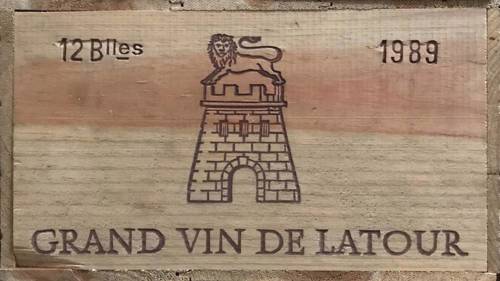
Château Latour’s distinctive emblem.
For centuries, the estate was in the hands of the Mullet family, and life revolved around agriculture with vines that flourished. However, the transformation of the estate began when it passed by descent to the de Ségur family. Capitalising on the rich soils and perfect growing conditions, the de Ségurs began making serious wine and by the second generation Nicholas-Alexandre de Ségur had been dubbed the ‘Prince of the Vines’ by Louis XV and had enlarged the family estates.
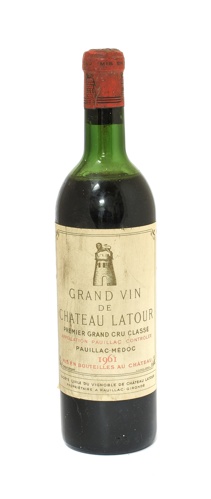
Grand Vin De Château Latour 1961 Pauillac-Médoc – Sold for £2,200
During the 18th century, Château Latour became well established, with wines that had a reputation for excellence. Trade was flourishing. The de Ségurs, now a powerful family, managed to retain the estate, with most of their lands intact, during the French Revolution.
In 1855, Napoleon III requested a classification system for wines from Bordeaux for the Paris Exposition Universelle, in order to rank the top wines of the region based on price and reputation. Château Latour was one of four given the top ranking, and designated ‘Premier Cru’, literally translated as ‘First Growth’, the others being Château Lafite Rothschild, Château Margaux and Château Haut-Brion.
Château Latour remained under the family’s control until 1962, when the English financial group Pearson became the majority shareholder, with 25% being held by Harveys of Bristol. Harveys later became Allied Lyons, who became the majority shareholder in 1989 with 93%, and the remaining 7% in the hands of the de Ségur family. In 1993 François Pinault under the guise of Artemis, purchased the estate and continues to pursue excellence today.
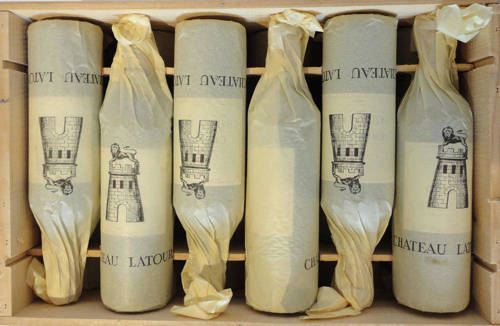
Chateau Latour 1982 Pauillac – Sold for £12,700
Today, the estate spans 78 hectares, with 190 acres of vines, 80% or which are Cabernet Sauvignon, with 18% Merlot and 2% Cabernet France and Petit Verdot.
Château Latour is one of the most sought-after wines at auction, and has achieved extraordinary prices over the years, from an 1863 vintage realising £15,600 per bottle and a Magnum of 1926 vintage selling for £9,000 at Christie’s in 2018, and an Imperial (6 litres) sold for £135,000 in 2011. At Tennants, notable sale have included twelve bottles of Chateau Latour 1982 Pauillac, which sold for £12,700 in 2012, and a bottle of Grand Vin De Château Latour 1961 Pauillac-Médoc, which sold for £2,200 in 2023.
To learn more about buying or selling wine at Tennants, click HERE
All figures exclude buyer’s premium.