
William De Morgan (1839-1917) was one of the most influential and innovative potters of the Arts and Crafts movement, creating vibrant designs that drew inspiration from the Renaissance, the Medieval era and the Islamic world. His creativity wove together whimsical imagery, fantastic beasts and complex patterns with technical innovation that revolutionised art pottery in the Victorian age.
Born to liberal parents, his father was a professor of mathematics and his early lessons in the discipline would reappear in De Morgan’s designs in the form of complex geometry and symmetry and a scientifically inquiring mind. De Morgan, however, lent towards the arts and set out to become a fine artist. A formal artistic education at the Royal Academy put De Morgan in the same circles as the Pre-Raphaelite greats, but halfway through his training and disillusioned with his attempts to become a painter, a meeting with William Morris at his showroom set him on a new trajectory. Inspired by Morris’ philosophy and creativity, a sideways move into the Decorative Arts suited his technical inclinations and he began to design stained glass for Morris in the 1860s.
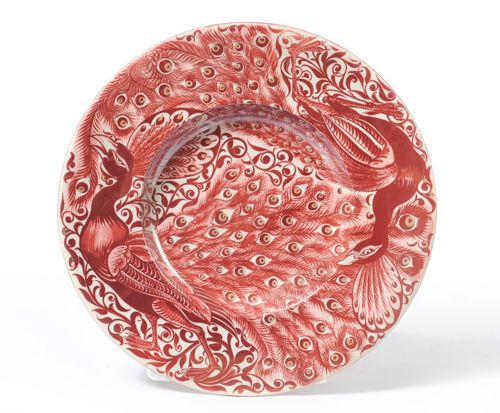
William De Morgan (1839-1917): A Charger - Sold for £2,800 plus buyer’s premium
Whilst making stained glass, De Morgan was to make one of his most important innovations. He noted that when the kiln-fired glass was starved of oxygen, an iridescent film formed on the surface. Realising this could be a way of recreating the lost method of making lustre-glazed ceramics that had been produced from 9th century Egypt to the Renaissance, he set about refining and mastering the technique.
Turning his attention to ceramics, he found a gap in the market for tiles and pottery for Arts and Crafts interiors and in 1872 established his firm in Chelsea, having blown the roof off his previous accommodation whilst experiment with a homemade kiln. He made wares with sophisticated geometric patterns and medieval-inspired designs that perfectly suited the Gothic Revival interiors of William Morris and his circle, which were flourishing thanks to a period of prolific home improvements. Whilst he had initially purchased blank tiles and pots from established potteries to which he added decoration, to align with Arts and Crafts principles of craftsmanship he moved the business to Merton Abbey, Wimbledon where Morris was based. Here there was space to create each piece from scratch, and his output from this period was rich with complex designs and ambitious techniques. Indeed, May Morris, William Morris’s daughter, once wrote of De Morgan, “The special bent of De Morgan’s invention was in winding beast forms and great sweeping lines round difficult shapes; the more difficult the space to be filled and the more fantastic the beast pattern, the more enjoyment is evident”.
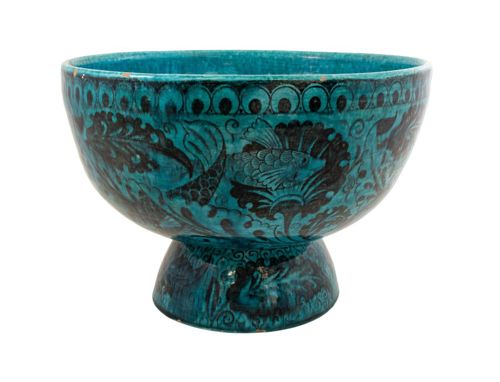
William De Morgan (1839-1917) for Cantagalli: A Faience Iznik-style Pedestal Punch Bowl - Estimate: £2,000-3,000 plus buyer’s premium. To be sold in the 20th Century Design Sale on 3rd October.
Having married the Pre-Raphaelite artist Evelyn Pickering in 1887, he regularly travelled to Florence for both his health and to visit Evelyn’s uncles. Here he collaborated with the master potters Cantagalli, who were renowned for their high-quality maiolica and recreating Renaissance designs. Combining Cantagalli’s elaborate vases with De Morgan’s imagination and patterns resulted in striking wares rich with mythological motifs.
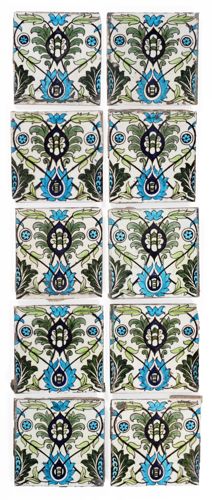
William De Morgan (1839-1917): Two Sets of Ten Early Fulham Period New Persian No.1 Chelsea 6" Fireplace Tile Panels - Sold for £2,000 plus buyer’s premium
De Morgan perhaps reached his creative pinnacle after his business moved to Sands End in Fulham in 1888; here he perfected his lustre glazes with an expert team, and a partnership with architect Halsey Ricardo gained him important commissions including large-scale tile design schemes in the ‘Persian’ style for Lord Leighton’s Holland Park home.
Always too caught up mastering technical challenges, De Morgan was not financially minded, and with changing tastes at the beginning of the 20th century the pottery was forced to closed in 1907. Writing the same year, De Morgan pondered, “All my life I have been trying to make beautiful things and now I can make them nobody wants them. Only my extinction will make them valuable”. Despite the esteem in which his ceramics are held today, De Morgan only made his fortune after his retirement from pottery, writing fiction that has now been all but forgotten.